Get in touch with Victorystar

How Does a Liquid Filling Machine Work? Understanding Its Role in Industrial Efficiency

Contents
show
The manufacturing efficiency is granted by an accurate and repeatable process. Liquid filling machines give precisely that—automating one of the most important production steps in industries from pharmaceuticals to food and beverage. These machines turn a manual, error-prone filling operation into a smooth system with consistent quality that outputs large quantities. A look at the working principle behind liquid filling machines reveals why they are deemed essential to modern manufacturing. Are you trying to decide on whether to automate your production line? Maybe you are just curious about how industrial processes work. In any case, you will find in this guide a detailed explanation of all the aspects of liquid filling technology such as working mechanics, types, and uses.
Introduction to Liquid Filling Machines
What is a Liquid Filling Machine?
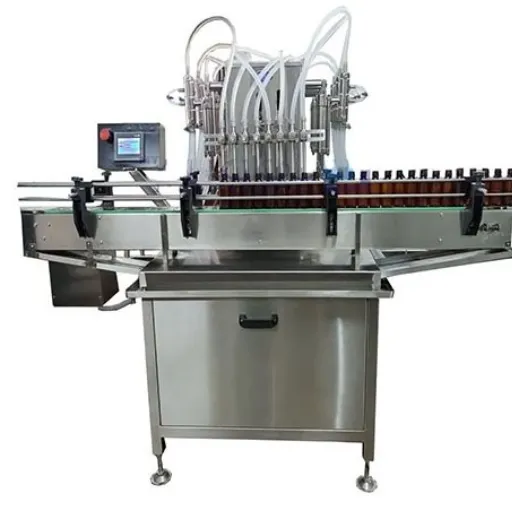
Liquid filling machines are automatic systems that fill containers with a given amount of liquid product. These machines are the replacement for manual methods of filling containers, where controls are used to measure and then transfer liquids in small quantities in milliliters. Mechanical and electronic controls are used to measure and transfer liquids of varying consistencies, ranging from thin water-like substances to thick pastes and creams. The modern-day packaging systems can fill from a few hundred to a thousand containers per hour, giving consistent output, which cannot be done manually.
Importance of Liquid Filling in Industries
In the absence of automated liquid filling, some major issues in manufacturing would arise. Firstly, product standardization is another important point: Every bottle is packed with the specified quantity of the product, so as not to waste material and to maintain the quality standards. Secondly, operators are kept away from injury and exposure to hazardous materials.
Indeed, speed matters. Manual filling operations are bottlenecks in production that limit output. Automated systems remove these limitations in production, allowing manufacturers to increase output without commensurate increases in labor costs.
Regulatory compliance poses the second significant reason for automation. Some industries like pharmaceuticals and food production are held under strict conditions for fill tolerance and contamination. The liquid filling machines satisfy these norms by way of controlled environments and accurate measurement systems.
Overview of Different Types of Liquid Filling
Different liquid filling machines employ different mechanisms depending on the characteristics of the product. Gravity fillers fit in well with thinner liquids, such as water or juices. Piston fillers come in handy for the thicker types of products, such as sauces and creams. Pump fillers accommodate foaming liquids that other systems cannot manage. The vacuum filling process permits filling that is under near vacuum or with the exclusion of air, whereas pressure filling is used for carbonated beverages. The decision depends upon the viscosity of liquids, container types, volume of production, and the specific requirements in the industry.
Mechanics of How a Liquid Filling Machine Works
Basic Components of a Liquid Filling Machine
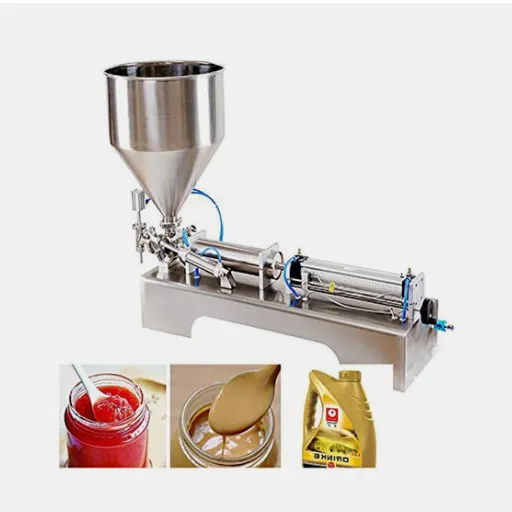
Every liquid filling machine contains several essential elements. The product reservoir holds the liquid awaiting dispensing. Fill heads—the nozzles that actually dispense product—connect to the reservoir through tubing or pipes.
The control system manages the entire operation. Today the machines are fitted with PLCs that allow an operator to change the fill volumes, speeds, or timing with great precision. Sensors will monitor the fill level or even the presence of the container, so if it is not properly positioned it will not dispense.
Conveyors convey containers to and from the filling station. Some systems provide capping machines that seal the containers immediately after filling, thereby completing the packaging line. The frame and mounting systems form the structural support structure. Industrial machines are generally constructed of stainless steel for makers’ durability and cleanability, which is essential for food and pharmaceutical-grade machines.
Key Components at a Glance:
- Product Reservoir: Holds liquid awaiting dispensing
- Fill Heads: Nozzles that dispense product into containers
- Control System (PLC): Manages volumes, speeds, and timing
- Sensors: Monitor fill levels and container presence
- Conveyors: Transport containers through the system
- Frame/Mounting: Provides structural support (typically stainless steel)
How the Filling Mechanism Operates
In the filling procedure, a sequence of steps are establish to be followed. Containers come to the fill station by conveyor belt. The sensors locate the position of containers and signal the system to start filling. Either the fill head lowers or the container is raised to the proper position. The product is sent into the container from the reservoir through the fill head. The control system measures the quantity dispensed through time measuring and hence filling, volumetric or weighing device.
After the flow has stopped once the target volume is obtained, the fill head retracts, and the conveyor moves the filled container onto the next station while bringing the empty container for filling. This cycle repeats throughout the production runs. A different filling mechanism can perform different types of measurements. Time systems calculate volume by controlling the time for which the valve stays open. Volumetric systems use a cylinder or a chamber of known volume. Weight systems place the container on a scale during filling and stop it when the target weight is reached.
The Filling Process: Step-by-Step
Step
Action
1
Containers arrive at fill station via conveyor
2
Sensors detect container position and signal system
3
Fill head descends to proper position
4
Product flows from reservoir through fill head
5
Control system measures dispensed volume
6
Flow stops when target volume is reached
7
Fill head retracts and conveyor advances container
8
Cycle repeats with next empty container
Understanding the Role of Piston Fillers
Arguably among the most versatile of filling mechanisms are filling by piston. In essence, the system comprises a cylinder and piston similar to a syringe. On the intake stroke, the piston is pulled back, and the product is sucked from the reservoir into the cylinder via an intake valve. On the delivery stroke, the piston pushes the product through an outlet valve and fill nozzle into the container. The volume of the cylinder corresponds to the fill quantity, i.e., larger pistons translate into more product delivered per cycle.
Since piston versus fillers for heavy substances like pastes, creams, and sauces, a piston filling machine is large in size. The piston filling systems will set these products containing the particulates like salsa or jams that would otherwise clog any other kind of filling system. The positive displacement action maintains fairly accurate filling regardless of the product consistency. Multiple-head piston fillers fill several containers at once, increasing throughput. The independent operation of each head also enables the system to tolerate some slight variations in container positioning or timing.
Types of Liquid Filling Machines
Automatic Filling Machines vs. Manual Filling
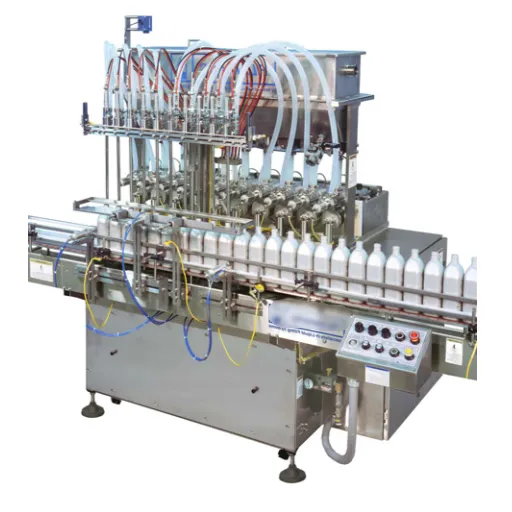
Automatic filling machines run continuously, with little intervention from humans. Operators load empty containers onto the conveyor, observe the system operation, and offload the finished product. The machine handles filling and can be connected with capping and labeling systems for fully automated processes. Semi-auto is more operator-involved. An operator places each container on the fill platform to start the filling cycle and removes the container once filled before proceeding to the next. Such machine configurations suit for lower volume operations or applications where changes in products happen frequently.
Filling manually is a method that is still practiced in places where it is small-batch production, as they use measuring cups or simple dispensers. Nonetheless, even small-batch productions often justify installing semi-automatic systems to improve consistency and reduce labor. Automatic filling is another way to fill containers: higher throughput, higher precision, and lower per-unit costs at scale. Capital investments are higher, but quicker returns are expected for manufacturers producing in the order of thousands of units per day.
Comparison: Automatic vs. Semi-Automatic vs. Manual Filling
| Feature | Automatic | Semi-Automatic | Manual |
|---|---|---|---|
| Operator Involvement | Minimal (monitoring only) | Moderate (place/remove containers) | High (complete manual control) |
| Production Volume | High (thousands daily) | Medium (hundreds daily) | Low (small batches) |
| Accuracy | Highest (±0.5% or better) | High (±1-2%) | Variable (±5%) |
| Capital Investment | Highest | Moderate | Lowest |
| Labor Costs | Lowest per unit | Moderate per unit | Highest per unit |
| Best For | Large-scale production | Medium-scale/frequent changeovers | Small batches/specialty products |
Exploring Bottle Filling Machines
Basically, bottle filling machines fill bottles of various sizes and materials. These systems accept containers made of glass, plastic, and metal, wherein changeover procedures permit very rapid switching between bottle types. Rotary bottle filling machines transfer containers through filling stations on a rotating carousel. Such a design maximizes throughput for high-speed operations. Inline filler lines walk bottles straight through the filling station, securing simpler operation and easier maintenance on lesser volumes.
Influenced by numerous variables, filling operations guarantee the absolute uniformity of fill volume. An overflow filler level fills a bottle to the same height, befitting minor volume differences from container to container. Determining having discrepancies in appearance of the product is a loss; this is critical in retail display. Specialized bottle filling machines deal with peculiar problems that involve how beverages retain carbonation or how cleaning products prevent foam from forming. Counter-pressure filler will keep the pressure around the liquid while it is being filled, preventing the loss of carbonation in beer or soft drinks.
Different Filling Types and Their Applications
Gravity Filling
Uses gravity to transfer product from reservoir to container. Best for thin, free-flowing liquids like water, juice, or wine. Simple, reliable, and cost-effective for appropriate applications.
Pressure Filling
Applies pressure to force liquid into containers. Works well for foamy products or applications requiring fast fill times. Commonly used for carbonated beverages.
Vacuum Filling
Creates vacuum in the container, drawing liquid in through atmospheric pressure differential. Minimizes oxidation and foam, making it ideal for products sensitive to air exposure.
Pump Filling
Uses rotary pumps, gear pumps, or peristaltic pumps to move product. Handles a wide viscosity range and works well with shear-sensitive products. Common in cosmetics and personal care applications.
Overflow Filling
Fills to a consistent level rather than volume, creating uniform appearance. Essential for retail products where visual consistency matters.
Key Takeaway: Each filling type offers specific advantages. Manufacturers select systems based on product characteristics, container type, production volume, and budget constraints.
Industries Utilizing Liquid Filling Machines
Food and Beverage Industry Applications
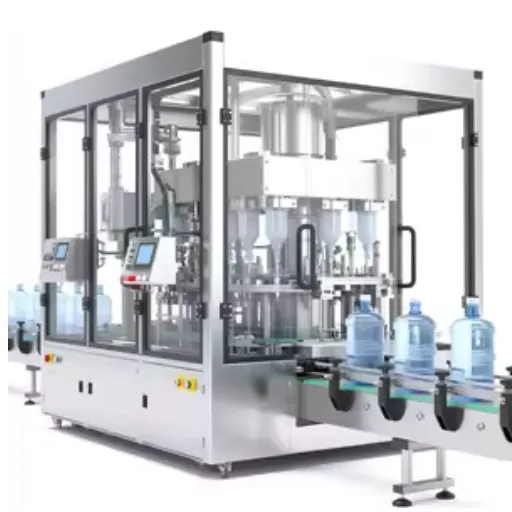
Food and beverage manufacturers put liquid filling automation to all sorts of applications. Water, for example, is filled in bottles through high-speed rotary fillers with a capacity of a few thousand per hour, while wine is filled under more careful conditions. Sauce and condiment manufacturers use piston infiltrations to fill the thicker substances like ketchup, mayonnaise, and salad dressings. Dairy operation fills milk, yogurt, and other such dairy products with such systems designed for sanitary operation and easy cleaning.
Unless at the moment of filling, there is a danger of dripping and the deviation from correct weight prevailing. Fruit juices and concentrates, on the other hand, are filled by employing hot-fill technology wherein sterilization of the product takes place during filling. Food-grade material, most of the time stainless steel, prevents contamination and allows thorough cleaning in between production runs. CIP systems can automate cleaning, thus reducing downtime and labor-intensive cleaning operations, with confirmed sanitation.
Pharmaceutical and Chemical Industries
High accuracy throughout processes and contamination control demands pharmaceutical manufacturing. The liquid-filling machines in this industry fill medications, vaccines, or other critical products where accuracy means patient safety. These machines operate within controlled environments, sometimes cleanrooms, that reduce airborne particulates. Fill accuracy needed is beyond what standards require and tolerances are in fractions of milliliters.
Chemical manufacturing concerns filling implementations of such huge variety for hazardous materials. They may be corrosion-resistant materials, sealed systems, and explosion-proof electrical components protecting the operators and the plant. Whether serialization and track-and-trace capabilities, they integrate with pharmaceutical filling lines for product tracking throughout the supply chain, as required by regulations.
Cosmetics and Personal Care Product Filling
It is the operation of filling the products with Cosmetics and Personal Care consisting of liquid foundations, shampoos, lotions, etc. These applications are delicately handled to preserve texture and appearance of the products. Pump fillers are applied for creams and lotions that can provide controlled flow rates with dropping splashes or aeration. Overflow fillers provide consistent fill levels for products for retail display.
The perfume and fragrance filling process requires systems that prevent evaporation and conserve the product’s integrity. Nail polish filling includes manufacturing systems for products with specific viscosity characteristics and mixing systems to maintain color consistency. The process of rapid changeovers between personal care products of a different kind or shade sometimes needs to occur and is supported by contemporary filling systems through quick-change fill-heads or automated cleaning cycles.
Industry-Specific Filling Applications
| Industry | Common Products | Preferred Filling Method | Key Requirements |
|---|---|---|---|
| Food & Beverage | Water, juice, sauces, condiments, dairy | Gravity, Piston, Hot-fill | Food-grade materials, CIP systems, sanitation |
| Pharmaceutical | Medications, vaccines, syrups | Piston, Peristaltic pump | Cleanroom operation, extreme accuracy, serialization |
| Chemical | Industrial chemicals, cleaning solutions | Pump, Piston | Corrosion resistance, sealed systems, explosion-proof |
| Cosmetics | Lotions, foundations, perfumes, nail polish | Pump, Overflow | Gentle handling, quick changeovers, visual consistency |
Enhancing Efficiency with Liquid Filling Machines
Benefits of Automation in Filling Processes
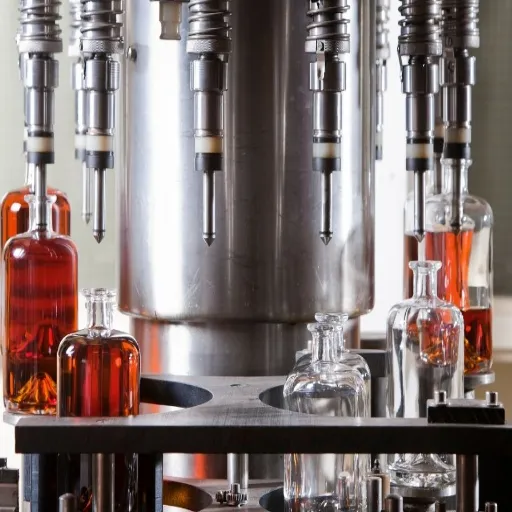
Automated filling gives quantifiable benefits on many counts. Typically, filling accuracy jumps from nearly ±5% deviation under manual to within ±0.5% or better under automatic, thereby minimizing product giveaway and ensuring regulatory compliance. Another considerable factor that shoots up with filling speed- wherein the manual system allows fill rates of 20-30 containers per minute, automated systems generally fall somewhere between 100-300 containers per minute, depending on the product and container type.
The labor cost is reduced by using machinery for filling containers instead of human labor. Operators now are able to focus on machine monitoring and maintenance and usually manage more than one production line at once. There is an improvement in quality consistency due to removal of human inconsistencies by machinery. Each container is filled with the exact amount specified, thereby maintaining the quality standards and customer satisfaction levels. Traceability is enhanced through data collection systems integration. The modern system stores data such as fill volume, production rates, and quality metrics, thereby providing documentation for both regulatory compliance and process improvement.
Automation Benefits: Manual vs. Automated Filling
| Metric | Manual Filling | Automated Filling | Improvement |
|---|---|---|---|
| Fill Accuracy | ±5% | ±0.5% or better | 10x more accurate |
| Production Speed | 20-30 containers/min | 100-300 containers/min | 5-10x faster |
| Quality Consistency | Variable | Highly consistent | Eliminates variability |
| Labor Requirements | High per unit | Low per unit | Significant reduction |
| Product Waste | Higher (overfill/spillage) | Minimal | Major reduction |
| Data Tracking | Manual logs only | Automated real-time data | Complete traceability |
Integrating Conveyors and Capping Machines
The filling machine alone is insufficient for a packaging line; it must connect with upstream and downstream equipment. Containers are smoothly conveyed between stations at constant spacing and orientation. The container is sealed immediately after filling in capping machines to minimize exposure time to contaminants and ensure prevention against any evaporation. Inline systems then place caps and torque them to a specific tightness while ensuring the piece is not damaged or the threads are not scratched. Labeling machines affix product information, batch codes, and branding. There exist vision systems that check cap presence, fill levels, and label placement, reject any defective units, and prevent such from jumping onto Conveyor 2 at shipping. Stage integration requires machine-speed coordination as well as container handling. Modern systems use electronic synchronization to ensure a smooth flow of product without bottlenecks or gaps.
Complete Packaging Line Integration
- Container Supply: Empty containers loaded onto conveyor system
- Container Transport: Conveyors move containers with consistent spacing
- Filling Station: Automated filling machine dispenses precise volumes
- Capping Station: Caps applied and torqued to specification
- Labeling Station: Product information and branding applied
- Quality Inspection: Vision systems verify fill levels, caps, and labels
- Product Collection: Finished products removed for packaging/shipping
Reducing Waste and Increasing Productivity
Filling with precision reduces product waste. Overfilling simply generates an expense for the manufacturers-as goodwill to the consumer. Underfilling, on the other hand, will create an unapproved product parity situation with laws and consumer dissatisfaction. Automated machines, however, prevent both. Few spills and drips mean little cleanup will be necessary and little product loss will occur. Proper filling systems contain the product within the filling area, preventing conveyors and surrounding equipment from being contaminated. Changeovers between products are faster, increasing productive operating time. Quick-change components and automated cleaning systems reduce downtime from hours to minutes in the best-design installations. These predictive maintenance approaches minimize unplanned downtime in the long term. Sensors monitor wear on components and trigger maintenance activities before a failure occurs, thereby preventing costly production stoppages and extending equipment life. Optimized operation also improves energy efficiency: Modern control systems adjust machine speeds to production requirements, cutting energy consumption during periods of low-volume production.
Productivity Enhancement Strategies
Waste Reduction
Precise filling eliminates overfill and underfill issues, reducing product giveaway and compliance problems
Spillage Control
Contained filling areas minimize cleanup requirements and prevent product contamination
Quick Changeovers
Automated cleaning and quick-change components reduce downtime from hours to minutes
Predictive Maintenance
Sensor monitoring prevents failures before they occur, eliminating costly production stoppages
Energy Optimization
Smart controls adjust speeds based on demand, reducing energy consumption during low-volume periods
Quality Consistency
Automated systems eliminate human variability, ensuring every container meets specifications
Reference Sources
How does a liquid filling machine work? – Explains the piston-based mechanism and its accuracy in handling various liquids.
How Does A Filling Machine Work? All You Need To Know – Covers the purpose and working principles of filling machines, including time, weight, and volume-based systems.
Understanding Different Types of Liquid Filling Machines – Provides an in-depth guide to different liquid filling machines and their applications.
How Does a Filling Machine Work – Details how liquid filling machines ensure precise filling and manage excess product efficiently.
How Automatic Liquid Filling Machines Improve Efficiency – Highlights how automatic machines enhance efficiency and maintain consistent flow rates across production scales.
Frequently Asked Questions (FAQs)
How Does a Liquid Filling Machine Work?
The liquid filling machine makes sure that a definite quantity of a liquid is dispensed into a container. The machine has over a hundred filling techniques, first being volumetric, wherein the volume is measured before the actual dispensing, or gravity filling, dependent upon the weight of the liquid. Pumps may funcion as fillers in the case of thick liquids, while pistol fillers might be used where control is necessary. The filling process of the liquid filling machine might be either fully automatic or semi-automatic in an integrated processing line of various industries, depending upon the type of the filling machine. The liquid filling machines are basically used for liquid packaging so that the fill amount is consistent and less wastes are generated.
What Are the Different Types of Filling Machines Used?
There are several types of filling machines used in the industry; each serves a particular purpose. Piston fillers work best for thick or viscous liquids, while overflow filling systems fill thin liquids with an equal level of fill. Gravity filling machines are utilized mostly for lighter liquids, and pump systems cover anything in between viscosity grades depending on or on their pumping capability. Equipped with rotary machines are excellent for high-speed production lines, while manual operating machines provide great leeway for small batches. Having an understanding of these different types of filling equipment aids companies in making the right choice for their needs.
How Do Automatic Filling Machines Operate?
With programmed sequences during operations, automatic fillers can fill containers without any manual intervention. These machines utilize sensors and controls to detect the presence of containers and ensure that the exact volume of liquid is dispensed. The filling heads open and close so that liquid flows only when required. In the meantime, conveyors move the containers through the filling area. Automatic filling machines are designed for maximum efficiency and often incorporate capping and labeling machines to provide a fully automated packaging solution. Large volumes are handled well enough to make these filling equipment a manufacturerÕs best choice in giving slight touches to production processes.
What Is the Role of a Piston Filling Machine?
In the filling area, piston filler accurately dispenses liquid or semi-liquid product into containers. It uses the piston mechanism inside a cylinder to lift the liquid up between fills into the chamber and then allow the product to fall into the container. It is excellent for filling higher viscosities and generally assures a constant amount of liquid. Filling machines are used quite commonly by large companies involved in food and beverage, cosmetics, and pharmaceutical industries because of their reliability and ability to be easily adjusted for the change of container size and fill volume.
How Do Filling Machines Ensure Consistent Fill Levels?
Few machines can fill so uniformly with a particular liquid, requiring specialized measuring instruments and technologies. The great majority of them use volumetric or gravimetric systems, each of which must be capable of measuring the exact amount that goes into a container. In addition, such machines have features for adjusting the filling heads and for programming calibrations for different container sizes and types of liquid. Keeping machines well maintained and regularly calibrated is critical to ensuring that they will remain reliable and accurate throughout the years. This way, manufacturers could limit variation and achieve high-quality packaging of liquids.
What Is the Importance of Liquid Packaging in Manufacturing?
The liquid packaging area becomes very important in all types of manufacturing, in order to protect the products and maintain their quality during storage and transportation. Effective packaging solutions minimize contamination and keep the product from spoiling, which is extremely important in case of perishable items. The other application of liquid packaging is for branding and marketing; for instance, attractive packaging will lure consumers. Choosing the filling machine gives the packaging line its efficiency, allowing the manufacturer to keep up with demand while making sure that the correct amount of liquid is filled in each container. Bottom line is that quality liquid packaging helps support business growth and customer satisfaction.
How Do Capping Machines Work with Liquid Filling Machines?
Along with liquid filling machines, capping machines complete the packaging operation. Containers filled with liquid come to the capping station where the capping machine firmly seals them. Usually, this is done to ensure product integrity and to check and prevent leakage. The machines could be employed either manually or fully automatically depending on production needs. Various techniques are used in applying caps of various kinds: screw tops, snap-on caps, and many others. Such machines inside the production line help speed up operations and maintain standard quality in liquid packaging.

DU
Articles: 45
Trending now