Get in touch with Victorystar

Ice Cream Production Line Equipment for sale
Pump up your ice cream production with super-efficient machinery of varying scales. Check out our various ice cream production line equipment for sale.
Defect-recognition imaging by deep learning algorithms is 99.9% accurate. It learns and improves over time.
Observing with real-time in the cloud dashboards. Any place in the world remotely diagnosed and controlled.
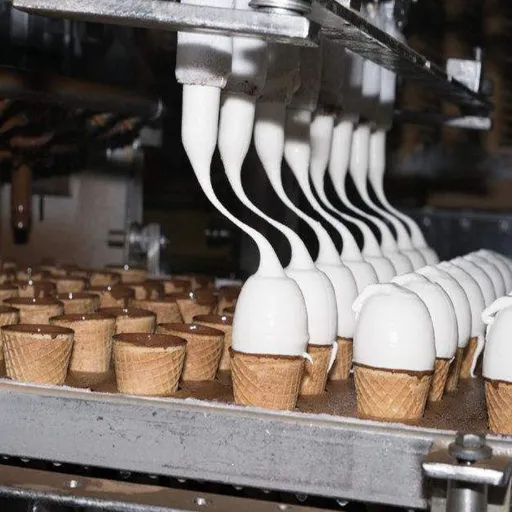
Every step from mixing to packaging is automated, involving the precision and fast robotic handling.
Event-based AI equipment failures. Maintenance can be rescheduled during normal downtime and not emergency situations.
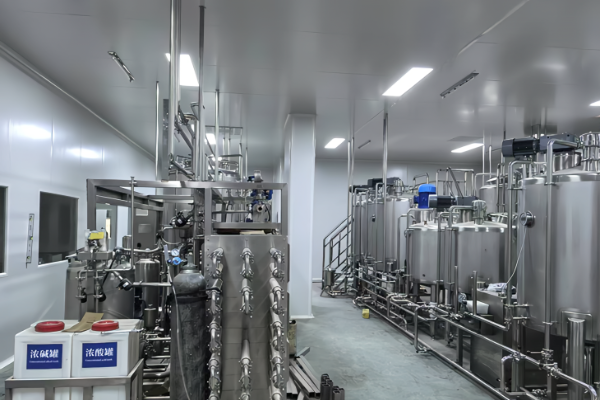
An unlimited concoction of flavors and product forms. Recipe management with secure storage.
Energy-efficient components and CO2 refrigeration. Heat recovery systems also help reduce environmental impacts.
Small production lines (100L/h), medium production lines (500L/h), or large production lines (4,000L/h) are easily upgraded in capacity.
Automated safety monitoring, emergency stops, and compliance with international safety standards.
Are These Challenges Holding Your Production Back?
The manual method causes variations in texture, flavor, and appearance. It would mean 576 wasted products every day, in a 24-hour operation with a defect rate of 1%, which amounts to thousands of lost revenues.
✅ Our Solution: AI-Powered Infrared Quality Control and Machine Vision systems are used to identify defects unrecognizable to the human eye and inspect every product in real time. About 99.9% quality consistency can be achieved.
There is a problem of dependency on operators, at least eight per shift, hard seasonal hiring, high training cost, and human errors during critical production phases.
✅ Our Solution: Full Production Line Automation should diminish the labor force by 70%. The cobots take charge of the repetitive tasks and perform them with extreme precision and consistency 24/7, thus relieving seasonal staffing concerns.
The manual handling of ingredients leads to clumping, bridging, dosing inaccuracies, and ingredient waste of 5-8%, translating directly to profit margin.
✅ Our Solution:Automated Ingredient Handling System with precision dosing impact on Big Bag station with anti-bridge technology to reduce waste by 85% and ensure batch-to-batch consistency.
Unexpected equipment failure stops production, causes the melted product to be lost, and missed delivery deadlines.
✅ Our Solution: With Predictive Maintenance with IoT Sensors monitoring 200+ data points continuously, the system can predict failures before they occur; hence, it increases uptime by 35% and cutting emergency repairs by 90%.
Unsteady freezing crystallizes texture, reduces shelf life, and guarantees customer complaints and returns.
✅ Our Solution: AI-Controlled Continuous Freezers with real-time temperature adjustment make optimal ice crystal formation and maintain consistent overrun. Perfect texture through CO2-based sustainable freezing every time.
Without real-time data on production efficiency, ingredient usage, or quality metrics, the operations cannot be optimized or immediate responses given to any arising issue.
✅ Our solution:Offering real-time analytics from every line machine, OEE tracking, full traceability from raw materials to the finished product, and mobile alerts, the Ice Cream Line Insight™ Dashboard is the real-time operational system.
Ice Cream Production Equipment Technical Specifications
| Equipment Type | Key Features | Specifications |
|---|---|---|
| Mix Pasteurization Units | - Batch or continuous pasteurization - Homogenization - Plate heat exchangers | Capacity: 300-3,000 L/h Viscosity: Up to 2000 cPs Temperature: 72°C for 15 seconds (HTST) |
| Continuous Freezers | - High-quality ice cream production - Air incorporation (overrun control) - Compact design | Capacity: 300-1,500 L/h Dasher Speed: 150-250 RPM Refrigerant: R502 or similar |
| Batch Freezers | - Small-batch production - Customizable flavors - Manual or semi-automatic operation | Capacity: 2-150 qt per batch Freezing Time: 5-7 minutes Overrun: Up to 100% |
| Ingredient Feeders | - Controlled addition of mix-ins - Gentle mixing | Suitable for nuts, candies, fruits Hopper with discharge valve Rotary or screw-type pump |
| Ripple Pumps | - Syrup and sauce injection - Temperature control for liquid chocolate | Stainless steel hopper Jacketed hopper with heating elements Precise dosing |
| Filling Machines | - For cones, cups, tubs - Semi-automatic or rotary systems | Applications: Cones, cups, family packs Customizable filling patterns |
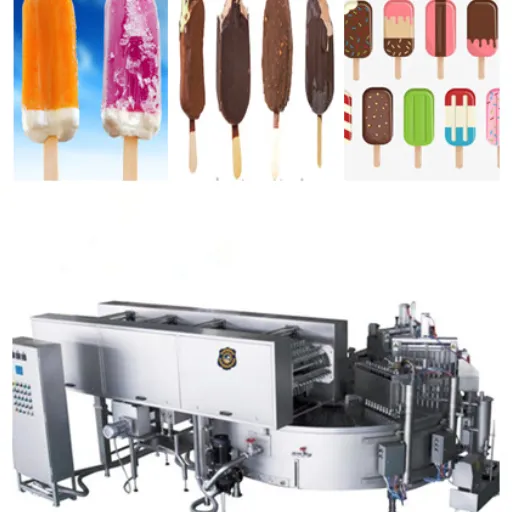
| Stick Molding Machines | - Popsicle and ice cream bar production - Hygienic standards | Automatic production line Suitable for industrial-scale production |
| Dosing and Pumping Units | - Accurate dosing of liquid ingredients - Gentle handling | Handles chocolate, caramel, fruit puree Precise temperature control |
| CIP Systems | - Automated cleaning for hygiene - Reduces downtime | Centralized cleaning for tanks, freezers, and pipelines |
| Homogenizers | - Ensures uniform texture - Breaks down fat globules | High-pressure operation Improves emulsification |
| Refrigeration Systems | - Essential for freezing and hardening - Direct expansion cooling | Refrigerant: R502 Compressor: Semi-hermetic Condenser: Water-cooled or air-cooled |
| Automation & Controls | - Microprocessor-controlled - Monitors viscosity, overrun, and pressure | Programmable settings Emergency shutdown and defrosting |
Proven Results Across the Industry
85%
Reduction in Raw Material Waste
70%
Lower Labor Costs
35%
Increase in Production Uptime
99.9%
Quality Consistency Rate
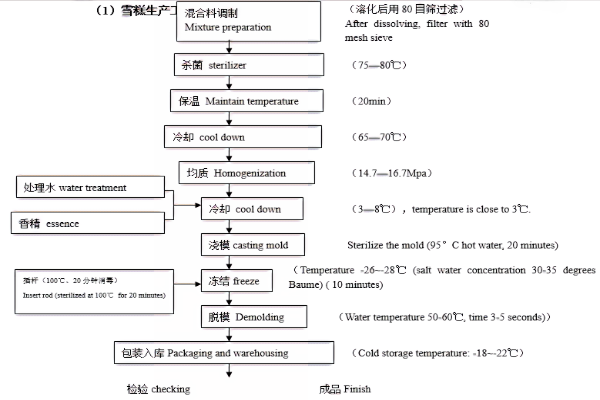
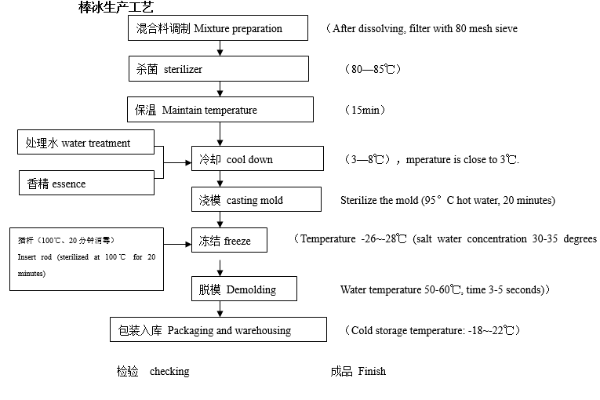
Ice Cream Manufacturing Process Flow Chart
Figures 1 and 3 are the production process flow charts of ice cream, and Figure 2 is the production process flow chart of popsicles.

Versatile Product Capabilities Of The Ice Cream Processing Line
One line, unlimited possibilities
01
Soft Serve
Smooth and creamy soft ice cream with ideal texturing and overrun management
02
Hard Ice Cream
A traditional hard ice cream in cups, tubs, and bulk containers.
03
Ice Cream Sticks
Popsicles with coatings, swirls, and filled centers in funky shapes.
04
Ice Cream Cones
Pre-filled cones with chocolate coating and toppings.
05
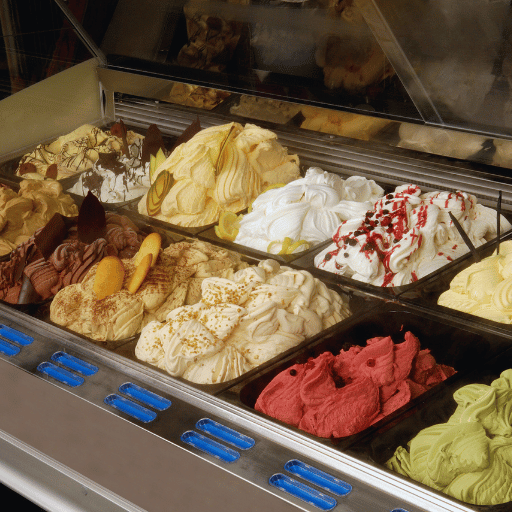
Gelato
The local artisan gelato with punchy flavors and dense texture.
06
Special Products
Low-fat, sugar-free, lactose-free, organic, and vegan.
07
Ice Cream Cakes
Layered ice cream cakes that are decorated and custom-made.
08
Coated Bars
Ice cream bars with chocolate or candy-type coating and inclusions.
Comprehensive Service & Support

What Is the Production Process of Ice Cream? From Ingredients to Packaging
One can consider ice cream as many things: a simple dessert, a treat, or a personality with myriad aromas, compositions,…
A Comprehensive Look at The Ultimate Guide to Ice Cream Production Line Trends
Ice cream has always been a worldwide treat, but the fast changes taking place in its making processes could not…
A Comprehensive Guide to the Top 10 Ice Cream Production Line Manufacturers Worldwide
To savor a scoop of creamy delight is an international pleasure, yet few are bothered with contemplating the complex procedure…
Expert Guides to the Ice Cream Production Line China
Ice Cream Production Line Price
Generally, this entire process of establishing an ice cream production line may cost anywhere from $20,000 to $300,000. Well, this price certainly depends on the scale of production, the very specs of the machine under consideration, and whether you are talking about an industrial ice cream plant being set up or just a pair of machines.
Prices Of Ice Cream Machine
Ice cream machines can cost differently, with more particular ones like the rolled ice cream machines beginning editions being $3,280. This means worthy commercial ice cream machines or unique ones for rolled ice creams will come at an array of prices to suit any budget or demand.
What is the production process of ice cream?
Several key steps make delicious ice cream. First, ingredients blend together. Then the mixture is pasteurized for safety. Next, the mix is homogenized so the texture is smooth. The mix ages so flavors develop. Finally, the mix is frozen into ice cream, additional flavors are introduced, and it’s packaged. Understanding the process allows one to appreciate their favorite frozen dessert.
What is 100% real ice cream?
Real ice cream consists of pure dairy components like milk, cream, and other products derived from milk. Generally, for the case of proper ice cream, at least 10% of the milk fat is contained. The real dairy ice cream guarantees the retention of texture and taste, deep, creamy, and genuine features, which come into being when only the true ingredients are imbibed.
Why do they put antifreeze in ice cream?
Additives such as propylene glycol, frequently viewed as antifreeze, are often employed in ice cream to prevent the danger of forming ice crystals, which would ensure a culinary smooth texture.
Why is vanilla the most popular ice cream flavor?
Vanilla remains the most popular ice cream flavor, and for good reason! Its universal appeal makes it versatile for nearly all desserts. People love the sweet, creamy, and complementary subtle taste of this classic flavor. Thus, plain vanilla ice cream is a timeless favorite, the No. 1 flavor consistently rated all over the world.
Process Of Making Ice Cream At Home
Making homemade ice cream is simpler than you might think! To make ice cream at home, one would use basic recipe ingredients including cream, milk, sugar, and flavorings of choice. After chilling this mixture, two main options present themselves. Either churn it in an ice cream maker for that classic creamy texture or opt for the no-churn method whereby after whipping, it simply is frozen without the use of a machine. Now, just sit back and enjoy your special frozen dessert!


What Our Customers Say
Real results from real businesses
With the installation of automation, the output has tripled. With production masseers less workerism-reducedby 65%. Consistently good quality, so customer complaints are inexistent these days. Best investment ever made.

Maria Rodriguez
Production Manager
Just from the predictive maintenance feature, we saved over $150,000 from emergency repairs. Before, we had breakdowns weekly, and now we do maintenance during scheduled downtime. The ROI was accomplished within the span of 14 months.

James Chen
Operations Director
Quick switching of flavors changed how we experience business. We can provide a lot more varieties–above 50 to be exact instead of 10. With AI quality control, defects that we, as human inspectors, would never have detected were caught, bringing waste down from 2.5% to 0.08%.

Sarah Thompson
CEO
Initially, we hesitated about investing, but the savings in energy alone pay for 30% of our monthly financing. The refrigeration system is tremendously efficient, the CO₂ being the refrigerant, and our carbon footprint has been appreciably lowered. And the cloud monitoring allows me to check production anywhere from hell.

Ahmed Hassan
Plant Manager
Frequently Asked Questions (FAQs)
A: An ice cream production line is a collection of machines and equipment designed to work side by side from start to finish to automate the entire process from mixing the raw materials up until packaging of the final ice cream products. There can be various ice cream products such as cones, cups, and tubs produced on these lines with maximum output and consistent quality.
A: Generally speaking, the process starts from mixing the ingredients, pasteurization, homogenization, and freezing, culminating into filling. These operations are streamlined by automated machinery so that manufacturers can efficiently produce large quantities of ice creams while maintaining top quality.
A: An industrial-style ice cream production line will have many pieces of equipment, including mixers, pasteurizers, continuous freezers, filling machines, and packaging machines. These are the machines that work together to allow the production line to run smoothly while producing good quality ice cream.
A: Automatic ice cream machines improve production efficiency by reducing manual labor and minimizing chances of human error. These machines automate all kinds of operations, which could involve mixing, freezing, and filling, to help the manufacturers scale production while maintaining consistent quality.
A: Yes, ice cream filling machines are adjustable so that they can ice cream into different shapes-the cone, the cup, or some unique molded forms. This allows manufacturers to make customized ice cream products according to different desires from consumers.
A: Stainless steel for its durability, ease of cleaning, and corrosion resistance is the most common material to make ice cream machinery. It is crucial for hygiene in the production process as well as for longevity.
A: Quality controls are maintained to assure the quality of ice cream during the production by applying quality checks at every step through the whole period of production, monitoring raw materials, maintaining processing temperatures, and keeping equipment in good working condition to avoid breakdowns in production.
A: The capacity of a small-scale ice cream production line varies and can be anything between several hundred and few thousand litres of ice cream. These production lines are designed for smaller manufacturers or artisanal producers that put emphasis on high-quality niche products.
A: Pasteurization is indeed a very important step in the making of ice cream wherein the mixture is heated to kill any harmful bacteria to establish a safe food. This treatment also allows an improvement to be made to the taste, consistency, and texture of the final product: the ice cream itself.
A: The ice cream manufacturers can automate production by investing in machinery that automates one or several stages of the manufacturing procedure, such as mixing, freezing, filling, and packing. Automation is thus one way to think about increasing efficiency while concentrating on the improvement of the product and market extension.
Trending now