Get in touch with Victorystar

UHT Sterilization: The Complete Guide to UHT Sterilizer Methods

Contents
show
UHT (ultra-high temperature) treatment is a cumbersome and pioneering innovation that imparts extended shelf life and ensures safety and quality for consumable goods, especially in the food and beverage industry. By contrast, UHT processing has the advantage of keeping down the influences of microorganisms unfavorable to consumers, yet still preserving the valuable nutritional, flavor, and texture proper- So, as an explanatory guide, it vividly discusses the science, mechanisms, and applications of UHT sterilization techniques, and attempts to throw light on the actual functioning with regard to their crucial uses in large-scale manufacturing. Whether you are into food technology, a quality assurance professional, or just curious about technologies associated with the safety and sustainability of food production, the article offers invaluable insights and numerous practical pieces of information.
Introduction to UHT Sterilization

Ultra-high temperature (UHT) sterilization is a thermal processing technique for liquid foodstuffs with the purpose of microbial destruction and hence prolonged shelf life. This technology involves rapidly heating the product at 135-150°C (275-302°F) for 2-5 sec and then rapidly cooling it. Exposure at a high temperature for a short period of time ensures inactivation of microorganisms while preserving the product’s nutritional and sensory properties. UHT processing is widely utilized in milk, juices, creams, and other beverages, allowing for extended shelf life at ambient conditions stably if the product is aseptically packaged.
Definition of UHT Sterilization
The UHT sterilization, or Ultra-High Temperature sterilization, refers to a thermal process through which pathogenic microorganisms and spoilage agents are eliminated from liquid or semi-liquid food products. The system is achieved by applying extreme heat at about 135°C to 150°C (275°F to 302°F) for 2-5 seconds, combined with microbial safety without compromising the taste, texture, or nutrition content of the product. The rapid heating-cooling mechanism will bring product stability, allowing long-term storage at ambient temperatures without the need of refrigeration and when sealed in a sterile, airtight environment. This technology is a necessary step in modern food-safety and food preservation principles.
Importance of UHT in Food Processing
UHT processing is significantly contributing to food safety and providing manufacturing efficiency in the current industry. The action not only produces a greater mass of food safeguarded against possible contamination but also promotes good deterioration of the food products (therefore maintaining the product’s sensory characteristics and nutritional value). The method offers real help to the food supply industry by enhancing the shelf life of otherwise perishable food products without refrigeration, which greatly cuts down on the inevitable coordinative complexity and hence handling/storage costs. Additionally, the strength of its holding-up quality beyond compromising parameters meets the present-day consumer cry for convenience and safety, making it an important tool in large food production.
Overview of UHT Technology
Ultra High Temperature (UHT) Technology is a process that aims at sterilizing liquid food products by heating them to long high temperatures ranging from 135 to 150°C for a very short time of 2-5 seconds. This fast heating, then quick cooling, eliminates microbial contaminating agents (mold herbal), accomplished with the least degradation to its components as well as an indefinite reduction of sensory properties. Different serious equipment, e.g. heat exchangers, or direct stream injection systems, allowing precise control of thermal conditions and creating energy-efficient operations, indicate requisite parameters for the process. Products that have undergone UHT treatment can be stored in aseptic packages for several long years without any need for being refrigerated, making this technology essential in the handling, marketing, and distribution of milk, juices, and other related liquid foods internationally.
How UHT Sterilizers Work

The UHT process works by quickly heating liquid food to such temperatures that lie between 135°C and 150°C for a shorter time ranging from 2 to 5 seconds. Rapid cooling is then employed. It can be done through either one of the two methods. In the direct method, steam is either injected directly into the product or utilized to heat the product in a controlled manner, whereas in the indirect method, heat exchangers are employed for the transfer of heat. Together with rapid heating and cooling cycles, enzyme deactivation and the complete eradication of any microorganism from the product are achieved without the slightest trace of material damage. The sterilized product is packed aseptically so that it can be kept shelf-stable for a considerable time without the need for refrigeration.
⚙️ Fundamental Principles of UHT Processing
The basic notion underlying Ultra-High Temperature (UHT) technology is safety from microbes and inactivation of enzymes through precise thermal treatment. Liquid products must be subjected to temperatures between 135 to 150°C for periods of 2 to 5 seconds so that all potentially infective microorganisms, including spores, be destroyed. Fast heating and cooling cycles allow for the product’s sensory and nutritional qualities to remain mostly intact, by effectively preventing the formation of severe heat damage. Aseptic packing greatly contributes to sterilization post-processing and is responsible for longevity of shelf life. This juxtaposition of high temperature and noncontaminated, hands-on procedures has made UHT technology highly effective and widely used across food industry applications.
Temperature Control in UHT Treatment
Control of the temperature is really important in UHT (Ultra-High Temperature Treatment) for both killing microorganisms and ensuring product quality. The process generally requires heating the product to temperatures from 135-150°C for about 2-5 seconds. It is important to maintain temperature in that narrow range to effectively destroy pathogens, including heat-resistant spores, while avoiding excessive flavor, color, and nutritional degradation. High shear heat exchangers and monitoring systems are components of support technology to ensure an acceptable outcome per batch that is always consistent. The regulation for UHT-treated products or products processed via UHT is tough and this maintains the safety, stability, and sensory quality.
Heat Treatment Techniques
Heat treatment techniques in the spheres of the food industry, categorized by their temperature, duration of heating, etc., include some major approaches such as pasteurization, sterilization, and ultra-high-temperature UHT treatment. Pasteurization consists of short heat applications, usually in the range of less than 100°C, killing the non-spore-producing pathogens while shielding most of the nutritional and sensory attributes. Sterilizing agents held at a higher temperature, approximately 121°C, for a longer period to kill off all pathogens and spore producers, albeit to the detriment of lowered food quality attributes. UHT works at temperatures not below 135°C to avoid formation of any spores or germs, yet allowing a lot of fresh tastes to be preserved. These methods are chosen based on product type, shelf-life requirements, and the desired quality parameters.
Types of UHT Sterilizers

With regard to the inclusion of direct UHT systems, there are two types of UHT sterilizers:
1. Direct UHT Systems
In a direct system, steam is either injected directly or infused directly into the product, resulting in rapid heating and cooling that maintains the sensory and nutritional properties of heat-sensitive products. The most common are as follows:
- Steam Injection: Steam is injected into the product for instantaneous heating.
- Steam Infusion: This is the process of introducing the product into a chamber filled with steam for quick heating.
2. Indirect UHT Systems
In an indirect system, heat exchangers are used so as to transfer heat indirectly without physical contact between the heating medium and the product. Such systems are highly energy-efficient and can be used for a wide variety of applications. The types mentioned are as follows:
- Plate Heat Exchangers: These are employed highly in low-viscosity liquids.
- Tubular Heat Exchangers: Ideal for products containing small particulates or high viscosity.
- Scraped-Surface Heat Exchange: For those highly viscous products or with high concentrations of particulates.
Note: Both systems are to realize the same sterilization goals and still maintain product quality and efficiency. The selection relies on the type of products and processing requirements.
Batch vs. Continuous UHT Sterilizers
Batch and continuous UHT sterilizers are chalk and cheese when it comes to their working processes and efficiency. Overall, though a batch sterilizer offers more leeway to deal with different types of products and variable process conditions, a continuous-use system becomes indispensable for cost-effectiveness and the unusually uniform process flow required with high-velocity production lines. Alignment will depend on the factors like production scale, product characteristics, and operational objectives of a given industry.
Comparison of UHT Sterilization Technologies
The choice between batch and continuous systems for UHT sterilization lies on particular operational requirements. Batch sterilizers provide more flexibility as far as variety in product types is concerned, allowing acceptance of small volumes produced from different formulations, and hence wee-suited to the producers of niche or premium products. Continuous systems, however, are engineered for large throughput work designs: undoubtedly, their productivity is matched with high ‘energy efficiency’, less downtime, and constant product quality, and hence they seem ideally aligned for large production of one product type. The decision of selection should begin with fundamental considerations, like product variety, production scale, energy cost, long-range efficacy of in-service performance variables. A comprehensive analysis of these factors builds an alignment with the strategic manufacturing objective of the facility.
🔍 Choosing the Right UHT Sterilizer
While deciding on the proper UHT sterilizer, most importantly, one must figure out the kind of product being processed, the shelf life aimed for, production volume, and operational efficiency.
- For fluid and homogeneous products like milk or juices, tubular or plate heat exchangers usually turn out to be the most efficient as they generally provide high heat transfer rates and with great durability.
- In contrast, viscous or particulate products like soups or sauces thrive greatly on scraped-surface heat exchangers to effect uniform thermal propriety without compromising the integrity of the product.
- Their evaluation of energy efficiency should also include Scaffoldings to allow for the possible future growth in production.
Applications of UHT Sterilization
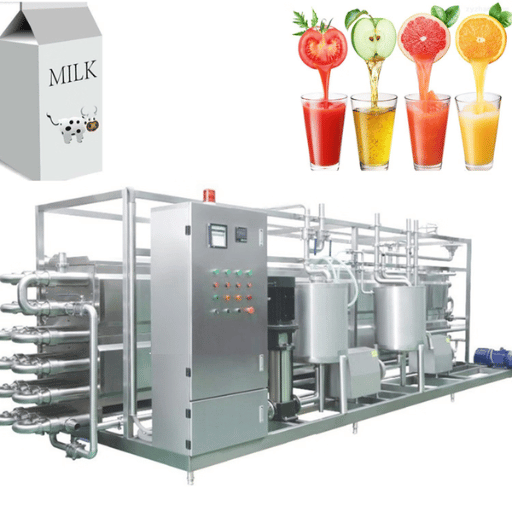
UHT sterilization is a fairly well-established technology today, with wide application in the food and beverage industries, particularly for the kind of products that can spend a long time without refrigeration. Some of the applications include:
🥛 1. Dairy
UHT treatment is available from milk, cream, and plant-based drinks as a method of retaining quality and vitality for some extended period.
🧃 2. Juices and Beverages
Fruits, tea, and ready-to-drink products require UHT sterilization for shelf stability and to make it safe to consume.
🍲 3. Soups and Sauces
Heat-processed soups and broths, together with liquid sauces, are UHT-treated to provide microbiological safety and extended shelf life.
👶 4. Infant Formulas
UHT processing supports both sterility and preservation for excellent safety standards.
These examples show the need for UHT methods for the preservation, safety, quality, and convenience of much-needed foods.
UHT Sterilization in Dairy Products
The UHT sterilization process applied in dairy products is critical for extending their shelf life without compromising nutrition and safety. This process requires the high heat treatment of milk and dairy products at 135°C-150°C for a few seconds in which harmful microorganisms are destroyed without damage to the important proteins, vitamins, and minerals. Post-treatment involving aseptic packaging thus prevents the product from becoming contaminated while in storage. This is an essential technology in the processing of dairy products of long shelf life that could just stand being kept out of the refrigerator on the shelf meeting modern customer demands of convenience and guarantee.
UHT Processing in Juices and Beverages
Juices and beverages undergo UHT processing by rapidly heating liquid products to ultra high temperatures (typically 135-150°C) for a few seconds before rapidly cooling it. This kills common spoilage microorganisms and pathogens while causing only minimal sensory and nutritional changes. In the case of juice, particularly the acidic ones, UHT treatment provides natural flavor with a longer shelf life, hence making it more desirable in the beverage industry. UHT technology shows long-term working sustainability by reducing the need for cooling by combining in aseptic packaging. This technology is in line with industry requirements which wish to achieve efficient and safe production.
Plant-Based Alternatives and UHT Treatment
For plant-based alternatives, UHT processing is highly successful in granting microbiological safety and shelf stability without compromising its nutritional or sensory attributes. This is particularly useful for non-dairy beverages such as almond, soya, and oat drinks, which are nutrient dense and hence highly prone to microbial spoiling. By applying UHT and aseptic processing, the operator meets the consumer’s need and desire for convenience, long shelf-stable storage life, and high-quality products, while still abiding by rigorous safety and efficiency operational standards.
Frequently Asked Questions (FAQs)
What is UHT Sterilization Equipment?
UHT (Ultra-High Temperature) sterilization equipment is utilized to sterilize liquids by the process of heating to very high temperatures (135 – 150°C) for a short time of residence to ensure the sterility and, consequently, to prolong the shelf life.
Which industries avail UHT sterilization equipment?
The food and beverage industry, the dairy processing industry, pharmaceutical manufacturing and the liquid food production industry are some of the industries that mostly take to UHT sterilization.
What are the advantages of UHT sterilization?
UHT sterilization makes the product last long, and allows for no refrigeration, and simultaneously preserves the nutritional and organoleptic properties of the product.
What documents are required in order to be sterilized by a UHT sterilizer?
Milk, juices, vegetable-based drinks, soups, sauces, and liquid pharmaceutics would be some works.
How does UHT sterilization differ from pasteurization?
UHT sterilization treats the product at much higher temperatures in a short time compared to pasteurization, thereby this treatment extends the shelf life of the product and it changes the taste profile.
📚 Reference Sources
- Pilotech – A Comprehensive Guide on UHT sterilization technology: Benefits using UHT sterilization such as safety, shelf life, and nutrition when properly applied.
- Food Machinery CH – A MUST HAVE when sourcing for Tubular UHT Sterilizer: Thoroughly examines the functions of beefy set organizations in food and beverage industries.
- LinkedIn – Market Overview on Plate UHT Sterilizer: Data on market segmentation, target user information, and opportunity with UHT Sterilizers is made available.

Candy
Articles: 37
Trending now